







 Einstein's theories of relativity revolutionized
 Naval communications


The Dispersion Transmitter
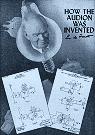
 You need to have your thinking cap on for
this article entitled, "The dispersion transmitter," which appeared in a 1944 issue
of Radio News magazine. It might be more aptly entitled, "The Dispersion Antenna," or "How to Use a Phase-Driven
Horizontal and Vertical Dipole Antenna Array to Effect a Circularly Polarized
Transmission Antenna Which Continuously Scans All Combinations of Azimuth and
Elevation Thereby Effectively Covering Every Point on the Earth's Surface
Reachable by Ionospheric Reflection." That last title describes the ingenious
system devised by author H.W. Kline. A description of tests run to verify the
operation is included. He mentions that the circularly polarized signals emitted
by the transmitter are usually received in a horizontally polarized orientation
after being reflected in the ionosphere. Using the antenna setup for receiving
signals does not benefit...
You need to have your thinking cap on for
this article entitled, "The dispersion transmitter," which appeared in a 1944 issue
of Radio News magazine. It might be more aptly entitled, "The Dispersion Antenna," or "How to Use a Phase-Driven
Horizontal and Vertical Dipole Antenna Array to Effect a Circularly Polarized
Transmission Antenna Which Continuously Scans All Combinations of Azimuth and
Elevation Thereby Effectively Covering Every Point on the Earth's Surface
Reachable by Ionospheric Reflection." That last title describes the ingenious
system devised by author H.W. Kline. A description of tests run to verify the
operation is included. He mentions that the circularly polarized signals emitted
by the transmitter are usually received in a horizontally polarized orientation
after being reflected in the ionosphere. Using the antenna setup for receiving
signals does not benefit...
Nation-Wide Television is Now in the Making
 Dr. Allen Du Mont played a huge role
in making television practical because of the improvements he made to the cathode
ray tube (CRT). Prior to his work, the lifespan of a CRT was measured in tens of
hours, and they were expensive, so their use was limited to special military and
research applications. Du Mont's interest in "wireless" began at an early age,
and he earned his commercial radio operator's license at the age of 14 (in 1915).
He designed and produced oscillographs (i.e., oscilloscopes) that incorporated his
CRTs. His involvement in the television industry was a natural evolution and extension
of the work done in related industries. The DuMont Television Network was formed
in 1942, rivaling the established CBS and NBC...
Dr. Allen Du Mont played a huge role
in making television practical because of the improvements he made to the cathode
ray tube (CRT). Prior to his work, the lifespan of a CRT was measured in tens of
hours, and they were expensive, so their use was limited to special military and
research applications. Du Mont's interest in "wireless" began at an early age,
and he earned his commercial radio operator's license at the age of 14 (in 1915).
He designed and produced oscillographs (i.e., oscilloscopes) that incorporated his
CRTs. His involvement in the television industry was a natural evolution and extension
of the work done in related industries. The DuMont Television Network was formed
in 1942, rivaling the established CBS and NBC...
How's Your Radio Geography?
 With a cover date of August 25, 1945, this
issue of The Saturday Evening Post obviously went to print some time prior
to the dropping of the two nuclear bombs on Japan that ended World War II. Victory
in Japan Day (V-J Day), was August 14, 1945. There is no hint inside the magazine
that the end of the war was nigh. There were, however, plenty of ads by companies
touting their contributions to the war, and even some ads, particularly food ads,
anticipating the end of rationing. Within this edition is also a short quiz entitled,
"How's Your Radio Knowledge?" The author, Captain James F. C.
Hyde, Jr., challenges readers to identify the locations of radio stations just
by looking at their call signs. As is done today, most stations attempt to get
call signs that are relevant to their location...
With a cover date of August 25, 1945, this
issue of The Saturday Evening Post obviously went to print some time prior
to the dropping of the two nuclear bombs on Japan that ended World War II. Victory
in Japan Day (V-J Day), was August 14, 1945. There is no hint inside the magazine
that the end of the war was nigh. There were, however, plenty of ads by companies
touting their contributions to the war, and even some ads, particularly food ads,
anticipating the end of rationing. Within this edition is also a short quiz entitled,
"How's Your Radio Knowledge?" The author, Captain James F. C.
Hyde, Jr., challenges readers to identify the locations of radio stations just
by looking at their call signs. As is done today, most stations attempt to get
call signs that are relevant to their location...
Highest TV Transmitter in Europe
 When I saw this photo of the
Mount Säntis television transmission tower in Switzerland, the
first thing I thought of was the scene in the James Bond "Moonraker" movie where
007 battles the infamous Jaws while riding a cable car. That took place in an area
around the Mediterranean though, so maybe it was "Where Eagles Dare" or some other
spy / military movie I was thinking of. The tower is featured on a Wikipedia webpage
where it states in part: "Located at the peak of the Säntis is a 123.55 meter
high transmission tower, which was commissioned in November 1997. The original
tower stemming from the year 1955 had to be renovated several times due to the
rough...
When I saw this photo of the
Mount Säntis television transmission tower in Switzerland, the
first thing I thought of was the scene in the James Bond "Moonraker" movie where
007 battles the infamous Jaws while riding a cable car. That took place in an area
around the Mediterranean though, so maybe it was "Where Eagles Dare" or some other
spy / military movie I was thinking of. The tower is featured on a Wikipedia webpage
where it states in part: "Located at the peak of the Säntis is a 123.55 meter
high transmission tower, which was commissioned in November 1997. The original
tower stemming from the year 1955 had to be renovated several times due to the
rough...
Westinghouse Models H-161, H-168, H-168A
 This Radio Service Data Sheet provides schematics
and parts lists for
Westinghouse Models H-161, H-168 and H-168A receivers. Most -
if not all - electronics servicemen had subscriptions to these magazines because
they were a ready source of not just these service sheets, but because of the extensive
articles offering advice on servicing radios and televisions. In fact, many electronics
manufacturers had a policy of supplying service data only to bona fide shops. A
large list is included at the bottom of the page of similar documents from vintage
receiver schematics, troubleshooting tips, and alignment procedures. They were originally
published in magazines like Radio-Craft, Radio and Television News,
Radio News, etc. I scan and post them for the benefit of hobbyists who
restore and service vintage...
This Radio Service Data Sheet provides schematics
and parts lists for
Westinghouse Models H-161, H-168 and H-168A receivers. Most -
if not all - electronics servicemen had subscriptions to these magazines because
they were a ready source of not just these service sheets, but because of the extensive
articles offering advice on servicing radios and televisions. In fact, many electronics
manufacturers had a policy of supplying service data only to bona fide shops. A
large list is included at the bottom of the page of similar documents from vintage
receiver schematics, troubleshooting tips, and alignment procedures. They were originally
published in magazines like Radio-Craft, Radio and Television News,
Radio News, etc. I scan and post them for the benefit of hobbyists who
restore and service vintage...
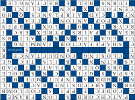
Engineering & Science Crossword Puzzle for October 20
 For two decades, I have been creating custom
engineering- and science-themed crossword puzzles for the brain-exercising
benefit and pleasure of RF Cafe visitors who are fellow cruciverbalists. This October
20, 2019, puzzle uses a database of thousands of words which I have built up over
the years and contains only clues and terms associated with engineering, science,
physical, astronomy, mathematics, chemistry, etc. You will never find a word taxing
your knowledge of a numbnut soap opera star or the name of some obscure village
in the Andes mountains. You might, however, encounter the name of a movie star like
Hedy Lamarr or a geographical location like Tunguska, Russia...
For two decades, I have been creating custom
engineering- and science-themed crossword puzzles for the brain-exercising
benefit and pleasure of RF Cafe visitors who are fellow cruciverbalists. This October
20, 2019, puzzle uses a database of thousands of words which I have built up over
the years and contains only clues and terms associated with engineering, science,
physical, astronomy, mathematics, chemistry, etc. You will never find a word taxing
your knowledge of a numbnut soap opera star or the name of some obscure village
in the Andes mountains. You might, however, encounter the name of a movie star like
Hedy Lamarr or a geographical location like Tunguska, Russia...
Progress in Television
 Prior to modern flat screen LED, LCD, and
(rarely anymore) plasma television displays, image projection systems ruled. Cathode
ray tubes (CRTs) dominated image displays from around the 1940 through the early
2000s. Prior to that electromechanical projection schemes were used to basically
magnify a small picture and display it on a larger screen - either from the front
or from the back. Some of the gizmos were pretty complicated with whirling plates
and clacking shutters. Dr. Vladimir Zworykin, who wrote this 1948 Radio-Craft magazine
article, is widely credited for making television practical with his image orthicon, or iconoscope, "camera" tube for capturing
real-time moving images in the transmitter. He also made significant
improvements in the cathode ray tube for projecting the images in the receiver.
RCA, for whom...
Prior to modern flat screen LED, LCD, and
(rarely anymore) plasma television displays, image projection systems ruled. Cathode
ray tubes (CRTs) dominated image displays from around the 1940 through the early
2000s. Prior to that electromechanical projection schemes were used to basically
magnify a small picture and display it on a larger screen - either from the front
or from the back. Some of the gizmos were pretty complicated with whirling plates
and clacking shutters. Dr. Vladimir Zworykin, who wrote this 1948 Radio-Craft magazine
article, is widely credited for making television practical with his image orthicon, or iconoscope, "camera" tube for capturing
real-time moving images in the transmitter. He also made significant
improvements in the cathode ray tube for projecting the images in the receiver.
RCA, for whom...
Carl & Jerry: Two Tough Customers
 Hmmm... this is the first time recall either
of Carl's or Jerry's father, at least where either was present in the story. Their
mothers are mentioned on occasion for providing sandwiches or uttering words of
caution when embarking on a sleuthing mission. In this episode entitled "Two Tough Customers," creator and author John T. Frye have
the techno-teens set out on an adventure to shop for a good deal on a fundamentally
sound car - which they would own in a partnership set up by their fathers. As you
would expect if you are an ardent C&J follower, their effort includes inspecting
not just the mechanical integrity but also the electrical system health. Frye always
used his stories as the basis for a lesson on some technical aspect of everyday
life. The boys broke teenage car owners into three groups: Hot-Rodders, Show-Offs,
and Mechs. They seemed to assign one trait or the other, but not a combination
thereof. Personally, I was a bit of all three with my first car - a 1969
Camaro SS. While reading, see if you notice what I did about the battery
measurement...
Hmmm... this is the first time recall either
of Carl's or Jerry's father, at least where either was present in the story. Their
mothers are mentioned on occasion for providing sandwiches or uttering words of
caution when embarking on a sleuthing mission. In this episode entitled "Two Tough Customers," creator and author John T. Frye have
the techno-teens set out on an adventure to shop for a good deal on a fundamentally
sound car - which they would own in a partnership set up by their fathers. As you
would expect if you are an ardent C&J follower, their effort includes inspecting
not just the mechanical integrity but also the electrical system health. Frye always
used his stories as the basis for a lesson on some technical aspect of everyday
life. The boys broke teenage car owners into three groups: Hot-Rodders, Show-Offs,
and Mechs. They seemed to assign one trait or the other, but not a combination
thereof. Personally, I was a bit of all three with my first car - a 1969
Camaro SS. While reading, see if you notice what I did about the battery
measurement...
Field-Effect Transistors
 The concept of a
field effect transistor (FET) has been around in theory for a
long time*, but manufacturable devices arrived in designers' labs not until the
early 1960s. This article from the October 1966 edition of QST magazine
gives a good introduction to the physics of a basic FET as well as the junction
FET (JFET) and the insulated gate FET (IGFET), all of which are still in
widespread use today. What you learn about them here is applicable today. In
fact, I swear some of the drawings are the same ones that appeared in my college
semiconductor physics text books (admittedly from the late 1980s, so not too
much of a surprise)...
The concept of a
field effect transistor (FET) has been around in theory for a
long time*, but manufacturable devices arrived in designers' labs not until the
early 1960s. This article from the October 1966 edition of QST magazine
gives a good introduction to the physics of a basic FET as well as the junction
FET (JFET) and the insulated gate FET (IGFET), all of which are still in
widespread use today. What you learn about them here is applicable today. In
fact, I swear some of the drawings are the same ones that appeared in my college
semiconductor physics text books (admittedly from the late 1980s, so not too
much of a surprise)...
Hallicrafters Radio Advertisement - End of War in Sight
 Here is another example of how enthusiastically
both manufacturers and consumers were met news of the impending end of World War II.
Amateur radio operators were amongst those most affected
during the war years because of the FCC having issued a moratorium against
transmissions, for security purposes. The same thing happened during World
War I, in fact*. Back in the day when citizens were fiercely patriotic and
appreciative of their freedoms, many Hams of service age answered a call to
donate certain kinds of equipment (panel meters, tuning capacitors,
transformers, etc.) for use in repair and retrofitting of field gear. They also
enlisted by the tens of thousands to lend their radio skills in the service of
their country. To the government's credit, the sacrifices were repaid
handsomely...
Here is another example of how enthusiastically
both manufacturers and consumers were met news of the impending end of World War II.
Amateur radio operators were amongst those most affected
during the war years because of the FCC having issued a moratorium against
transmissions, for security purposes. The same thing happened during World
War I, in fact*. Back in the day when citizens were fiercely patriotic and
appreciative of their freedoms, many Hams of service age answered a call to
donate certain kinds of equipment (panel meters, tuning capacitors,
transformers, etc.) for use in repair and retrofitting of field gear. They also
enlisted by the tens of thousands to lend their radio skills in the service of
their country. To the government's credit, the sacrifices were repaid
handsomely...
Electronic Analogy Quiz
 This
electronics analogy quiz is a little easier than many of the others
published in Popular Electronics magazine because all of the electrical
and mechanical objects depicted here are very familiar. The concepts might seem
trivial to those of us who have been immersed in the science for decades, but I
for one can remember when first hearing these analogies how helpful they were.
Not only that, but I also recall during physics and mechanics courses in college
being amazed at the similarity of equations shared by electrical and mechanical
processes. Wikipedia has a huge page describing many of the most familiar
mechanical-electrical analogies...
This
electronics analogy quiz is a little easier than many of the others
published in Popular Electronics magazine because all of the electrical
and mechanical objects depicted here are very familiar. The concepts might seem
trivial to those of us who have been immersed in the science for decades, but I
for one can remember when first hearing these analogies how helpful they were.
Not only that, but I also recall during physics and mechanics courses in college
being amazed at the similarity of equations shared by electrical and mechanical
processes. Wikipedia has a huge page describing many of the most familiar
mechanical-electrical analogies...
Crystal Finishing
 With a last name like Blattenberger and an
unusually spelled first (Kirt), I learned a long time ago not to poke fun at anybody's
name, but surely the parents of Dr. Hal F. Fruth had a sense of humor when
assigning their little bundle of joy in such a manner (HalF Truth?). Maybe I assume
too much. Anyway, the good doctor published in this issue of Radio News
magazine a very extensive treatise on the art and science of mass producing
radio frequency crystals at a time when the country - and free
world - was in urgent need of them. He notes that, "Prior to Pearl Harbor Day,
the world production of these plates and bars could be counted by the thousands.
The present production rate has skyrocketed more than one hundred fold so that
the present production rate is nearly 30,000,000 units per year...
With a last name like Blattenberger and an
unusually spelled first (Kirt), I learned a long time ago not to poke fun at anybody's
name, but surely the parents of Dr. Hal F. Fruth had a sense of humor when
assigning their little bundle of joy in such a manner (HalF Truth?). Maybe I assume
too much. Anyway, the good doctor published in this issue of Radio News
magazine a very extensive treatise on the art and science of mass producing
radio frequency crystals at a time when the country - and free
world - was in urgent need of them. He notes that, "Prior to Pearl Harbor Day,
the world production of these plates and bars could be counted by the thousands.
The present production rate has skyrocketed more than one hundred fold so that
the present production rate is nearly 30,000,000 units per year...
Amateur Broadcasting - A Menace
 J.K. Bach (not Johann S.) was amazingly prescient
in 1944 with the specific types of RF-based devices that would come to be common
place in our modern world. Dig this: "Radar can even be applied to the home, as
a burglar-alarm, for example, or to detect obstructions on the cellar steps. Electronic
devices will find many other uses as high-frequency paint-dryers, veneer-gluers,
and even cordless permanent-waving machines for the ladies. Garage-door openers
and other remote-control devices are not only possible but practical. Then there
are certain to be other applications such as personal pedestrian telephones, two-way
wrist-radios and nursery baby-cry announcing systems." Nostradamus' divination record
might not even be that good. His tongue-in-cheek thesis of
ubiquitous RF interference due to the presence of Ham radio
operators...
J.K. Bach (not Johann S.) was amazingly prescient
in 1944 with the specific types of RF-based devices that would come to be common
place in our modern world. Dig this: "Radar can even be applied to the home, as
a burglar-alarm, for example, or to detect obstructions on the cellar steps. Electronic
devices will find many other uses as high-frequency paint-dryers, veneer-gluers,
and even cordless permanent-waving machines for the ladies. Garage-door openers
and other remote-control devices are not only possible but practical. Then there
are certain to be other applications such as personal pedestrian telephones, two-way
wrist-radios and nursery baby-cry announcing systems." Nostradamus' divination record
might not even be that good. His tongue-in-cheek thesis of
ubiquitous RF interference due to the presence of Ham radio
operators...
For the Record...
 As I have pointed out in the past, by the
end of 1944, everyone - at least in the United States - was pretty much convinced
that World War II was all but done. Advertisements and articles in most of
the magazines were going full force with promoting a
plethora of great new consumer products that would soon be
flowing from post-war factories and into the homes of the families who had
sacrificed life, limb, fortune, and opportunity on the parts of fathers,
brothers, boyfriends, and husbands who fought Axis powers during the past four
and a half years. Parents, children, and wives of those who went "Over There"
played an invaluable part back home in the success by managing single-parent
households and filling in on jobs formerly performed by the servicemen. Life was
difficult at home and on the battlefield but they persevered. We still refer to
them collectively as "The Greatest Generation." Interestingly, one of the main
impediments to implementing the aforementioned grand plan was difficulty in
transporting raw materials and piece parts to manufacturing plants, and then
distributing finished goods to the stores. Recall that...
As I have pointed out in the past, by the
end of 1944, everyone - at least in the United States - was pretty much convinced
that World War II was all but done. Advertisements and articles in most of
the magazines were going full force with promoting a
plethora of great new consumer products that would soon be
flowing from post-war factories and into the homes of the families who had
sacrificed life, limb, fortune, and opportunity on the parts of fathers,
brothers, boyfriends, and husbands who fought Axis powers during the past four
and a half years. Parents, children, and wives of those who went "Over There"
played an invaluable part back home in the success by managing single-parent
households and filling in on jobs formerly performed by the servicemen. Life was
difficult at home and on the battlefield but they persevered. We still refer to
them collectively as "The Greatest Generation." Interestingly, one of the main
impediments to implementing the aforementioned grand plan was difficulty in
transporting raw materials and piece parts to manufacturing plants, and then
distributing finished goods to the stores. Recall that...
Unpopular Electronics
 You would be hard pressed to find an electronics
magazine today that included
poetry as part of its typical features. I have published pages
from the ARRL's QST magazine from the 1940s that had poems. Of course,
the theme of the poems is almost always humor or parody, but poetry was not an unknown
/ unpracticed art by the general populace as it appears to be today. Anyway, enjoy
the jovial rhymes here from the August 1959 issue of Popular Electronics.
Frequent comic contributor Carl Kohler provides the illustrations for the rhymes
of Saunder Harris...
You would be hard pressed to find an electronics
magazine today that included
poetry as part of its typical features. I have published pages
from the ARRL's QST magazine from the 1940s that had poems. Of course,
the theme of the poems is almost always humor or parody, but poetry was not an unknown
/ unpracticed art by the general populace as it appears to be today. Anyway, enjoy
the jovial rhymes here from the August 1959 issue of Popular Electronics.
Frequent comic contributor Carl Kohler provides the illustrations for the rhymes
of Saunder Harris...